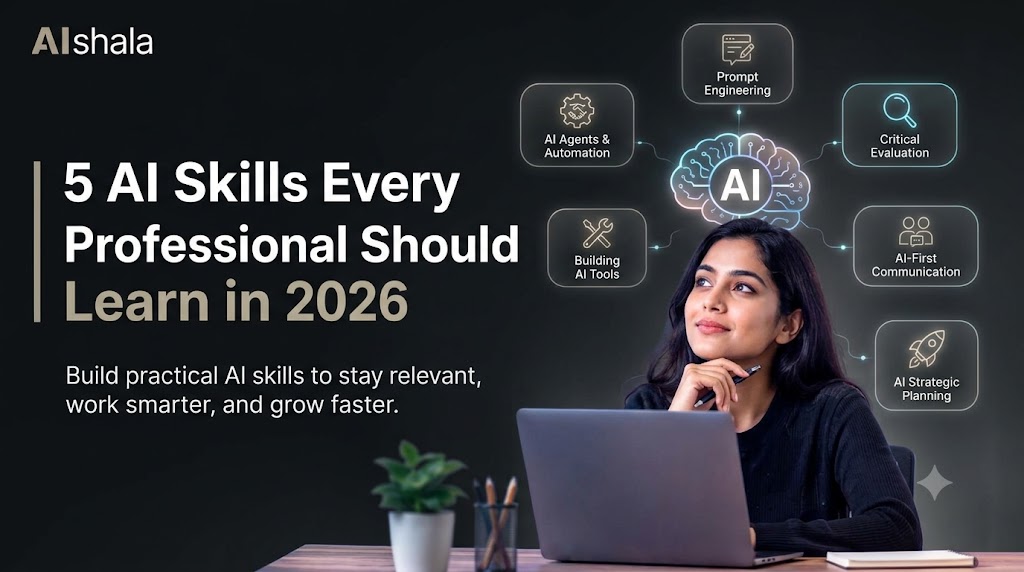
AI is no longer a “nice to have” skill — it's becoming a baseline expectation across almost every role. The good news: you don't need to become a data scientist to benefit. A handful of practical skills can go a long way.
1. Prompt Engineering That Actually Works
Most people use AI tools at a surface level. Learning how to write clear, structured prompts — with context, constraints, and examples — is one of the highest-leverage skills you can build in 2026.
Instead of simply asking AI to “write an email,” you can provide the background, explain the goal, define the tone, and specify the format you want.
The better your instructions, the more useful your AI output becomes.
Why it matters: Prompting is becoming a fundamental way of communicating with AI. Professionals who know how to get consistently useful results can save time and improve the quality of their work.

2. Using AI Agents for Repetitive Work
AI isn't only useful for answering questions. It can also help automate repetitive tasks.
Tools like n8n and custom AI agents can automate parts of your job that consume hours every week — including data entry, report generation, lead processing, and follow-up emails.
For example, an AI workflow could receive information from a form, analyze it, update a CRM, generate a report, and send a personalized email automatically.
You don't have to be an expert programmer to start understanding these workflows.
Why it matters: Automation allows you to spend less time on repetitive work and more time on strategy, creativity, and decision-making.
3. Evaluating AI Output Critically
AI models can sound extremely confident even when they're wrong.
They can produce incorrect information, outdated facts, fabricated sources, or misleading conclusions.
That's why learning to evaluate AI output is just as important as learning to use AI.
Build the habit of:
- Checking important facts
- Verifying sources
- Reviewing calculations and data
- Looking for unsupported assumptions
- Comparing important information with reliable sources
Think of AI as a powerful assistant — not an unquestionable authority.
Why it matters: Professionals who can quickly identify mistakes and validate AI-generated work will be trusted with more responsibility.
4. Building Small Tools, Not Just Using Them
You don't need to be a software engineer to start building with AI.
AI-assisted development, no-code tools, and low-code platforms make it easier than ever to create simple solutions for real problems.
You could build:
- An internal company chatbot
- A content research assistant
- A reporting dashboard
- An automated lead qualification workflow
- A document summarization tool
- A personal productivity assistant
The goal isn't necessarily to build complex software.
It's to learn how to identify a problem, describe a solution, create a prototype, and improve it.
This changes your mindset from AI user to AI builder.
Why it matters: Professionals who can turn AI into practical solutions can create value without waiting for large engineering projects.
5. Interview and Communication Skills for an AI-First Workplace
AI is changing what employers look for.
Technical knowledge still matters, but professionals increasingly need to demonstrate how they think, communicate, solve problems, and work alongside AI.
Employers may evaluate:
- Problem-solving
- Decision-making
- Communication
- Adaptability
- Collaboration
- Practical AI skills
Knowing an AI tool isn't enough. You also need to explain how you used it, why you made certain decisions, and what results you achieved.
Practicing with an AI interview coach can help you simulate realistic interview situations, receive feedback, and identify areas for improvement.
The Real Advantage: Combining AI With Your Existing Expertise
You don't need to completely change your career and become an AI specialist.
Your existing professional knowledge is still valuable.
A marketer who understands AI can improve research and content creation.
An engineer who understands AI can build and automate faster.
An accountant who understands AI can streamline reporting and analysis.
An operations professional who understands AI can automate repetitive workflows.
The biggest opportunity isn't AI replacing your expertise.
It's AI amplifying your expertise.
Start Building Your AI Skills Today
The AI landscape will continue to change rapidly. Tools will come and go, but the underlying skills — communicating with AI, evaluating its output, automating workflows, building practical solutions, and communicating your expertise — will remain valuable.
You don't need to learn everything at once.
Start with one skill. Practice it on a real problem. Then build from there.
That's the approach behind AIshala — practical, structured learning designed to help professionals build real-world AI skills through hands-on practice.
Whether you're learning how to use AI tools, automate workflows, build with AI, or prepare for your next interview, the goal isn't simply to know more about AI.
It's to use AI to do better work.
Ready to build your AI skills? Explore AIshala's courses and practice with Maya, your AI interview coach.