ChatGPT or Claude: Which One Should You Learn First?
Every week, someone just starting out with AI asks us the same thing: should I learn ChatGPT or Claude first?
It's a fair thing to wonder. They look alike. You type, they answer. Both are good enough that you honestly can't make a terrible choice. And both have fans online who treat the whole thing like a rivalry.
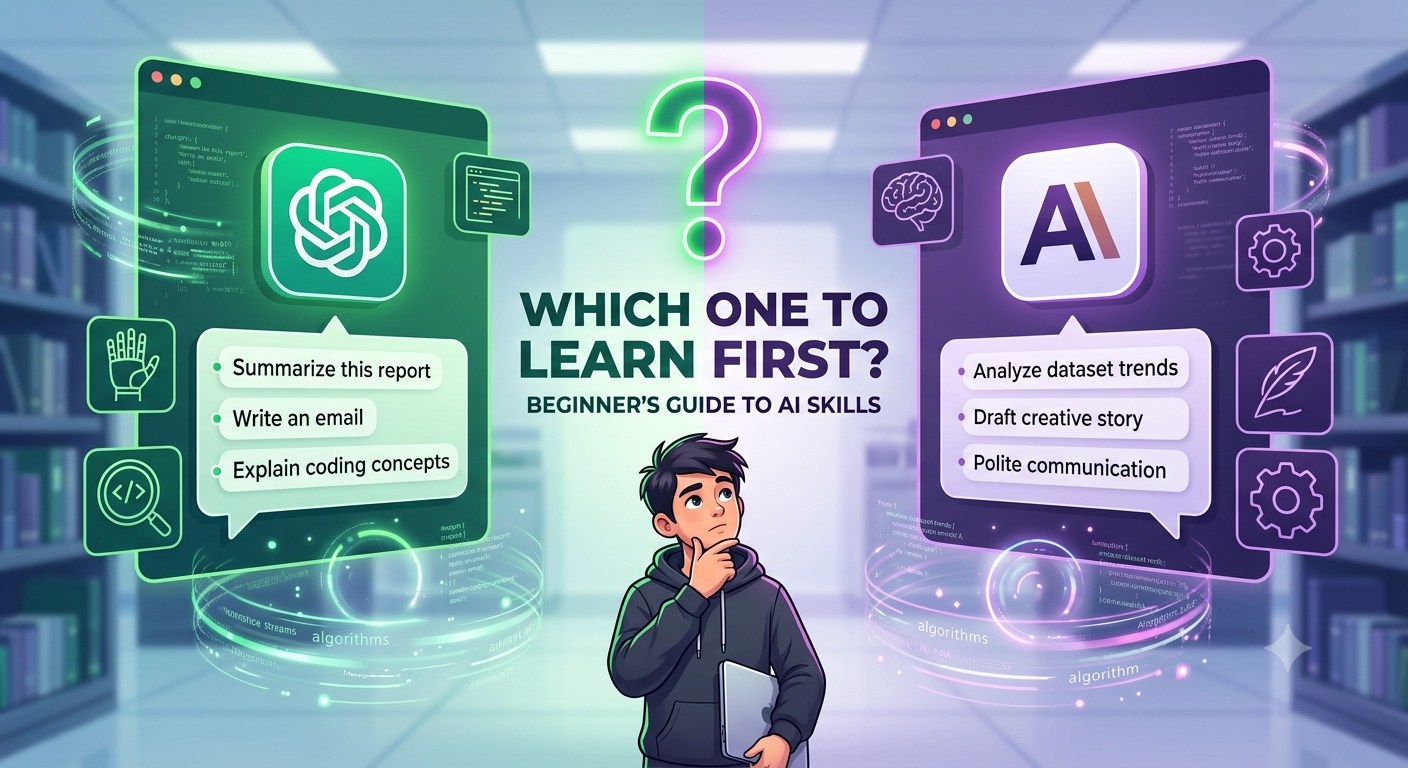
So let me skip the suspense. If you're completely new, start with ChatGPT, get comfortable, then try Claude a few weeks later. For most students and freshers, that order simply makes life easier.
But that's not the full story, and there are people for whom Claude is the smarter first pick. Let me walk through it the way I would if you asked me over chai.
The Short Version
If you want it in one line: beginners should start with ChatGPT, and people who mostly write should start with Claude. Here's the same idea as a quick reference.
Best first pick for
- ChatGPT: Total beginners, general use
- Claude: Writing-heavy work, long documents
Feels like
- ChatGPT: A busy toolkit with lots of features
- Claude: A calm, uncluttered writing space
Biggest strength
- ChatGPT: Huge community, tutorials, extra features
- Claude: Natural writing and long-document handling
Finding help
- ChatGPT: Easiest, help is everywhere
- Claude: Fewer tutorials around it
Free version
- ChatGPT: Yes, enough to learn on
- Claude: Yes, enough to learn on
What They Actually Feel Like to Use
Open ChatGPT and it feels like a busy toolkit. There's a lot packed in: image generation, voice, little custom tools other people have built, a wide menu of things to click. For a beginner that's exciting and a bit much at the same time.
Open Claude and it feels quieter. Fewer buttons, a big text box, and answers that tend to read like a thoughtful colleague wrote them. People who write for a living often prefer it for that reason alone.
Neither is better in some absolute sense. They're just different rooms to sit in, and part of choosing is knowing which room suits you.
Why ChatGPT Is the Easier Place to Start
Three honest, practical reasons.
First, almost everyone around you already uses it. When you get stuck, you can ask a classmate, search for a video, or drop your problem into any of a thousand tutorials, and the answer will be about ChatGPT. When you're learning, that support net matters more than any single feature.
Second, it grows with you. Once you're comfortable chatting, you can wander into images, voice, and custom tools without ever leaving the app. You won't outgrow it in a hurry.
Third, it's the name people expect. When a job post says "familiar with AI tools," or an interviewer asks what you've used, ChatGPT is the default they have in mind. Fair or not, that's where things stand right now.

Where Claude Genuinely Wins
I'm not going to pretend ChatGPT wins everything, because it doesn't.
If writing is the bulk of what you do (essays, reports, applications, long emails), a lot of people find Claude's drafts need less cleanup afterward. The tone lands closer to human on the first try.
If you often paste in long documents, say a full research paper or a heavy PDF, Claude tends to keep track of the details and give you careful summaries.
And if that calm, uncluttered feel appeals to you, that's a perfectly good reason on its own. You'll actually keep using a tool you enjoy opening.
So if you already know your main use is serious writing or reading long documents, starting with Claude isn't a mistake. For you, it might be the right call.
So, Which One Should You Pick?
Here's the recommendation, said plainly:
- New to all of this and not sure what you'll use it for: ChatGPT first.
- Mostly here to write and polish long text: Claude first.
- Prepping for placements or jobs where "AI tools" shows up in the requirements: ChatGPT first, since it's the assumed default.
Whatever you pick, give it a full two weeks before you judge it. Hopping between tools on day one is the surest way to learn neither properly.
You Don't Have to Choose Just One
This is the part people miss. It isn't a lifelong commitment. Most people who use AI seriously end up using both and switching based on the task.
A common rhythm: quick questions and brainstorming in ChatGPT, then move a serious piece of writing into Claude for a cleaner draft. Once you're at home in one, picking up the second takes an afternoon, because the core skill (writing a clear prompt) carries straight across.
That prompting skill is the real thing you're building. The tool is just where you practise it.
How to Start This Week
- Pick one using the guidance above, and don't agonise over it.
- Give it a real task from your own life, not a trick question. Rewrite your resume summary, or ask it to explain a topic that's been confusing you.
- Pay attention to what you liked and what annoyed you. That'll tell you more than any comparison article, this one included.
- After two weeks, open the other tool and run the same task. Now you can judge for yourself instead of taking anyone's word for it.
A Few Questions People Always Ask
Is Claude better than ChatGPT? Neither is simply better. ChatGPT has more features and a far bigger community. Claude is often preferred for writing and long documents. The right one depends on what you're doing with it.
Are they free? Both have free versions that are more than enough to learn on. You don't need to pay anything to start.
Can I learn both at once? You can, but it's slower while you're new. Get comfortable with one, then add the other. The second time goes fast.
Which one do employers expect me to know? Most job posts and interviewers still mean ChatGPT when they say "AI tools." Knowing it is the safe baseline, and adding Claude shows a bit of range.
Do prompts work the same in both? Mostly, yes. A clear prompt does well in either one. That's exactly why the skill matters more than the tool.
The Honest Bottom Line
You can't really make a bad choice here. Both tools are good, both are free to try, and whatever you learn on one carries over to the other. If you're still on the fence after all this, open ChatGPT today, spend twenty minutes giving it a real task, and stop reading comparison posts. You'll learn more in those twenty minutes than in any of them, this one included.
Want a proper way to get good, instead of just poking around? The AIshala 21 Day AI Challenge takes you through ChatGPT, Claude, and eighteen more tools one day at a time, with a small project every day. And when interviews come around, you can practise them out loud with Maya. Learn the tools first, then go prove you can use them.