How to Learn AI Without Coding: A Beginner's Guide
"I don't know coding. Can I still learn AI?"
Absolutely.
One of the biggest misconceptions about Artificial Intelligence is that you need to know Python, mathematics or machine learning before you can start.
That was more understandable when learning AI primarily meant learning how to build AI models.
Generative AI has changed that.
Today there are two very different ways to think about AI skills:
Building AI and Using AI
If you want to become a machine learning engineer or AI developer, programming and mathematics will eventually become important.
But if you want to use AI to become better at your current job, studies, business or creative work, you can start without writing a single line of code.
Here's how.
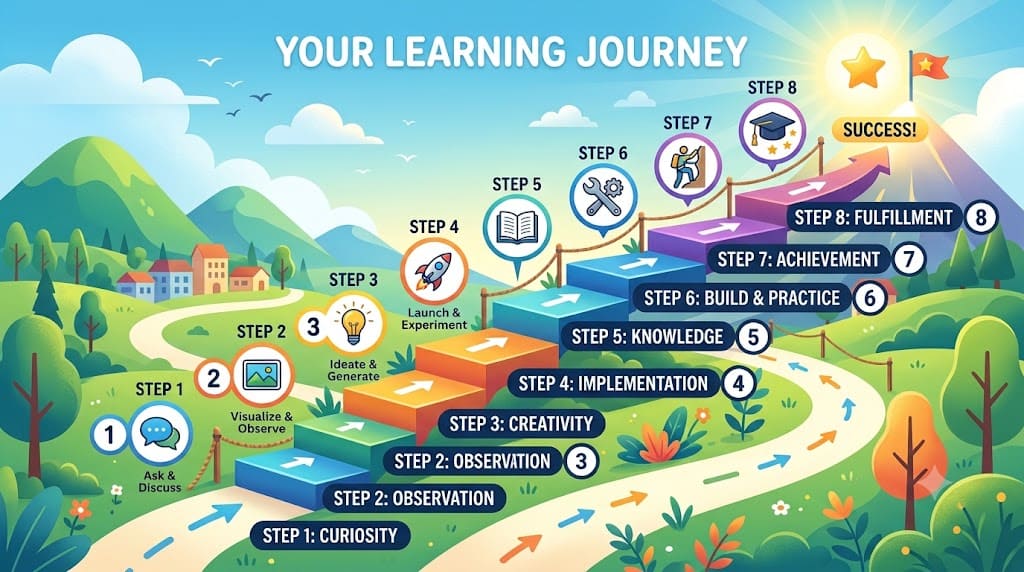
Step 1: Understand What AI Can Do
Don't begin by memorising technical definitions. Begin by understanding capabilities.
Modern Generative AI tools can help you:
- Write and rewrite
- Research topics
- Summarise documents
- Analyse information
- Brainstorm ideas
- Generate images
- Create presentations
- Work with spreadsheets
- Plan projects
- Learn new subjects
- Assist with coding
- Build simple applications
- Automate repetitive work
Once you understand what's possible, learning individual tools becomes much easier.
Step 2: Start with ChatGPT
For many beginners, ChatGPT is one of the easiest places to start.
Don't worry about complicated prompt-engineering frameworks initially. Ask it something useful. Then improve your instructions.
For example, instead of:
"Write an email."
try:
"Write a friendly follow-up email to a customer who attended our product demo yesterday. Keep it under 120 words and end with a clear next step."
You've already started learning one of the most important AI skills: giving AI better context and instructions.
Step 3: Learn Prompting
Prompting isn't about discovering magical phrases. It's about communicating clearly.
A useful prompt usually gives AI some combination of:
Context + Task + Requirements + Constraints + Desired Output
As you practise, you'll learn when to provide examples, when to assign context and when to ask AI to refine its own output. This skill transfers across many AI tools.
Step 4: Explore Gemini and Claude
Don't stop after learning one AI assistant.
Try the same task using ChatGPT, Gemini and Claude. Compare their responses. Ask each to summarise something. Ask them to brainstorm. Give them documents. Use them for research.
You'll quickly learn that understanding how to work with AI can be more valuable than memorising the interface of one particular tool.
Step 5: Learn AI Image Generation
Once you're comfortable with text-based AI, experiment with visual AI.
Learn how prompts affect:
- Subject
- Composition
- Lighting
- Camera angle
- Style
- Background
- Mood
- Aspect ratio
You'll begin seeing the same principle again: better instructions usually produce better outputs.
Step 6: Build Something Without Coding
This is where learning becomes exciting.
No-code and AI-assisted development tools increasingly allow people to turn ideas into prototypes without traditional programming experience.
Instead of simply reading about AI, try creating something.
- Build a landing page.
- Create a simple productivity tool.
- Design a presentation.
- Develop a content workflow.
- Create an AI-assisted research process.
The project doesn't need to become a startup. The purpose is to move from "I know about AI" to "I can build something with AI."
Step 7: Use AI in Your Existing Work
This may be the most important step.
Don't learn AI separately from your life. Apply it to something you're already doing.
If you're a student — Use AI to understand difficult concepts, create study plans, practise interviews and summarise notes.
If you're a marketer — Use AI for research, campaign ideas, copywriting, analysis and creative ideation.
If you're in sales — Use AI to research prospects, prepare for calls, personalise outreach and analyse conversations.
If you're an entrepreneur — Use AI for market research, brainstorming, presentations, content and prototyping.
If you're a freelancer — Use AI to improve research, accelerate delivery and expand the services you can provide.
AI becomes valuable when it becomes part of your workflow.
Step 8: Follow a Structured Learning Path
You can learn everything independently through free resources.
But beginners often face another problem: there is too much information.
One YouTube video teaches ChatGPT. Another talks about agents. Someone else says you need RAG. Then you hear about MCP, automation, vibe coding and another ten new AI tools. It's easy to become overwhelmed.
A structured platform such as AIshala can simplify the starting point. Instead of trying to figure out everything yourself, learners can progress through practical AI-tool courses, exercises, projects and Skill Challenges.
AIshala's learning philosophy is:
Learn → Practice → Build → Improve → Get Career Ready
The platform also includes Maya for AI-powered interview practice.
When Should You Learn Coding?
You don't need coding to start learning AI. But you may eventually want to learn it.
Consider learning Python if you become interested in:
- Machine learning
- Data science
- Building AI applications
- APIs
- Advanced automation
- LLM development
- AI agents
- Model training
The important distinction is sequence.
Don't tell yourself: "I need to learn Python before I can learn AI."
Instead: "I'll start using AI now and learn programming when my goals require it."

A Simple 30-Day No-Code AI Learning Plan
Week 1 — AI Fundamentals Understand Generative AI and start using ChatGPT.
Week 2 — AI Productivity Explore Gemini and Claude and apply AI to writing, research and everyday tasks.
Week 3 — Creative AI Explore image generation and other creative AI tools.
Week 4 — Build Use everything you've learned to create one real project.
At the end of 30 days, don't measure progress by the number of videos you've watched. Measure it by what you can do that you couldn't do before.
You Don't Need to Become an AI Engineer to Become AI-Skilled
AI is becoming part of almost every profession.
That means the future won't consist only of people who build AI. It will also include millions of people who become exceptionally good at working with AI.
You can be one of them without starting with coding.
Start with one tool. Learn it. Practise it. Build something. Then keep going.
Your first AI skill isn't coding. It's knowing how to use AI to solve a problem.