How to Catch an AI Mistake Before It Embarrasses You
There's a specific kind of embarrassment that comes from trusting AI a little too much. You quote a statistic in your assignment, and your professor asks where it's from. You mention a famous study in an interview, and the interviewer has never heard of it. You list a book in your project bibliography, and it turns out the book doesn't exist.
None of that means AI is useless. It means one small step got skipped: checking. And checking, once you know where to look, takes about thirty seconds.
This post is about building that habit, so AI makes you look sharp instead of careless.
Why AI Confidently Makes Things Up
This one idea explains everything else, so it's worth a minute. An AI tool doesn't look up facts the way you'd search a library. It predicts what words are likely to come next, based on patterns it picked up from a huge amount of text.
Most of the time, the most likely words are also true, which is why it's right so often. But sometimes the most natural sounding answer simply isn't correct, and the AI has no way of knowing the difference. It isn't lying. It genuinely can't tell when it's wrong, and it will invent a source, a number, or a quote with exactly the same confidence it uses for real ones. There's even a word for it: a hallucination, when the AI states something false as if it were fact.
That confidence is the trap. We're wired to believe things that sound sure of themselves. The fix is to stop reading confidence as correctness.
Where AI Mistakes Usually Hide
You don't need to double check everything. You need to know which parts to be suspicious of, and mistakes cluster in a few predictable places.
- Exact numbers and statistics. Percentages, dates, prices, study results. If a specific figure matters, verify it.
- Names, quotes, and citations. Who said what, which paper, which author, which year. This is where invented sources love to appear.
- Recent events. Anything that happened lately may be past what the AI knows, so it may just guess.
- Very specific claims. "The third tallest building," "the only country that." Precise superlatives are easy to get subtly wrong.
- Anything legal, medical, or financial. High stakes and full of exact detail, so treat these as starting points, never final answers.
- Math and calculations. It can slip on arithmetic that looks simple, so glance at the working.
Notice the pattern. The more specific and checkable a claim is, the more worth checking it becomes. Broad explanations are usually fine. It's the precise details that trip people up.
When to Relax, and When to Check
A simple way to hold this in your head.
Relax when you're using AI to brainstorm, explain a concept, draft something you'll edit, or think out loud. If the exact facts don't matter yet, you don't need to stop and verify anything.
Check when the output is heading somewhere real: an assignment you'll submit, a claim you'll say in an interview, a number in a report, a fact you'll repeat as true. The moment it leaves your private chat and goes in front of someone, it needs a look.
The 30 Second Check
When something does need verifying, here's the quick routine.
- Ask yourself: is this a specific, checkable claim? If yes, keep going.
- Search it. Drop the fact, name, or quote into a normal search and see whether real sources agree.
- Prefer original sources. A company's own site, the actual paper, a government page, not a random forum thread.
- If you can't find it anywhere, treat it as probably false, and cut it or replace it.
That's the whole routine. Most checks take less time than rereading the paragraph did.
You can also push back on the AI directly. Try "Are you sure? Give me the source for that number." Sometimes it corrects itself. But don't fully trust its second answer either, because it can invent a source to defend its first mistake. Outside verification always wins.

What Catching a Mistake Looks Like
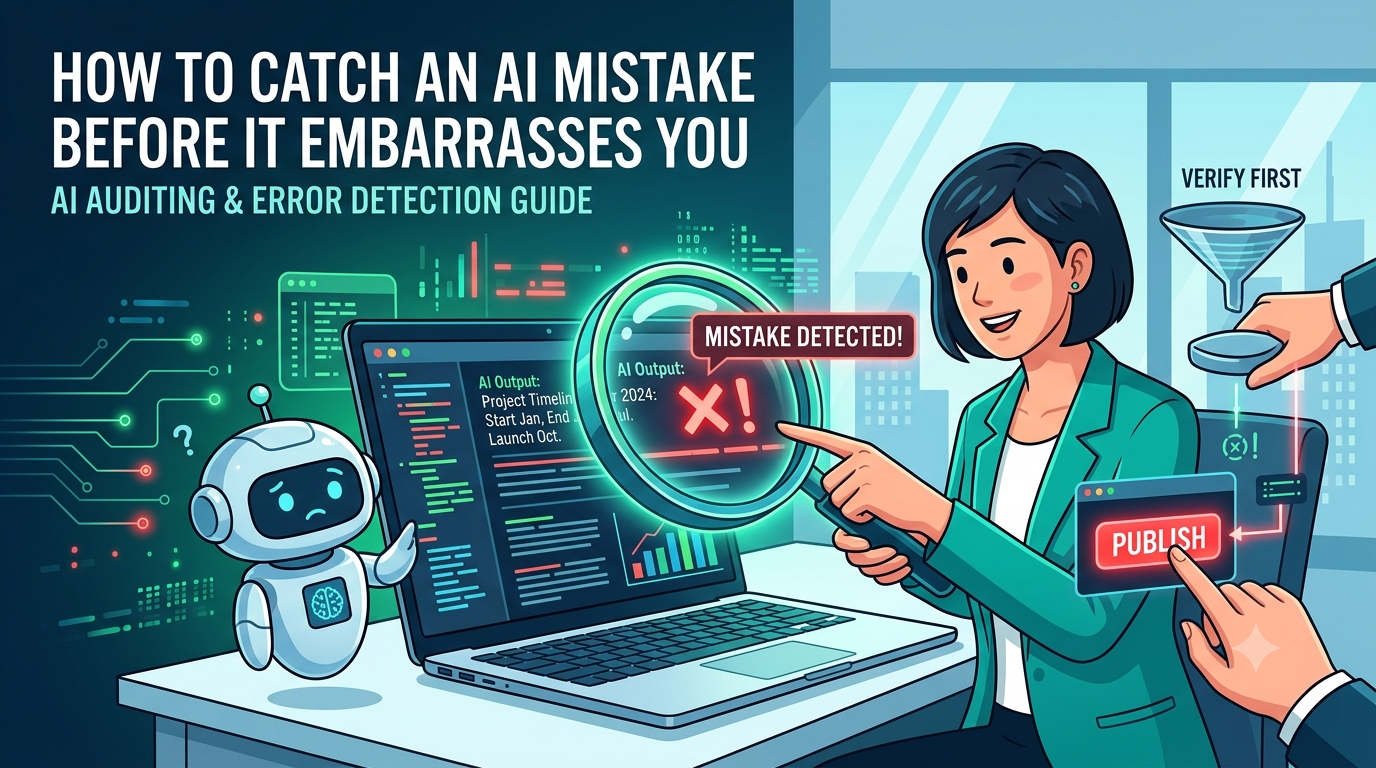
Say you ask for three studies on sleep and productivity, with authors and years. The AI hands you a tidy list. Before you paste it into your assignment, you search one author and title. Two are real. One returns nothing, anywhere. That third one is almost certainly invented, so you cut it. Thirty seconds just saved you from a citation your professor could have spotted in ten.
Or you're prepping for an interview and the AI tells you the company was founded in 2009 by two former Google engineers. Sounds specific. Sounds confident. You open the company's own About page. Wrong year, wrong founders. Now picture saying that line in the actual interview.
A Tool That Makes Checking Easier
Regular AI chat tools are built to sound fluent, not to cite sources. For anything fact heavy, a tool like Perplexity helps, because it gives you answers with clickable links you can open and confirm. Use your main AI to think and draft, and a source-based tool to check. They make a good pair.
The One Habit Worth Keeping
If you remember nothing else, remember this: trust AI to help you think, but verify anything you'll repeat as true. Confident does not mean correct. Say that to yourself every time a number or a name looks a little too neat.
Do it a few times and it stops feeling like a chore. It turns into a reflex, the same way you glance at a bill before paying it.
A Few Questions People Ask
Does this mean AI is unreliable? No. It's very reliable for thinking, explaining, and drafting. It's just not a source of truth for exact facts. Use it for the first, verify the second.
How do I know if a source it gave me is real? Search the exact title and author. If nothing comes up on any normal search, it's probably invented. Real sources leave a trail.
Can I just ask the AI if it's sure? You can, and sometimes it corrects itself. But it can also double down and invent proof. Checking outside the chat is the only reliable way.
Which topics need the most checking? Numbers, names, citations, recent events, and anything legal, medical, or financial. Broad explanations usually don't.
Is Perplexity better than ChatGPT for facts? For fact checking specifically, a source-based tool that shows links is easier to trust. For thinking and writing, your main chat tool is fine. Use both, for what each is good at.
The Bottom Line
AI is a brilliant assistant and a poor authority. The people who get burned are the ones who forget the second half. Once you build the reflex to check the specific, checkable things before they go public, AI quietly becomes one of the most dependable tools you own, because you've covered its one real weakness. That small habit is what separates someone who uses AI from someone who uses it well.
Want to build this the right way? This checking habit is the first thing you learn in the AIshala 21 Day AI Challenge, on Day 1, and you sharpen it again on Day 5 with a source-based research tool. Learn to trust AI where it's strong, and check it everywhere else. That's the whole skill.